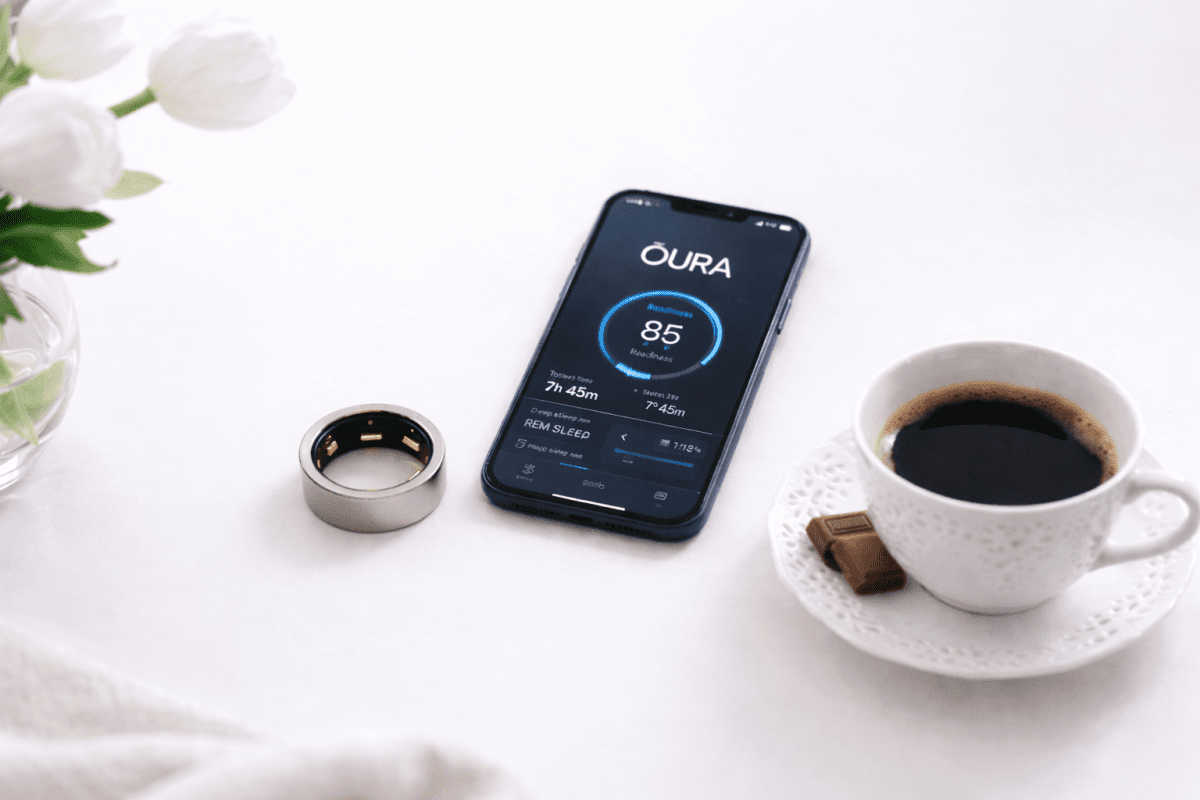
Most people assume they sleep well enough.
They fall asleep eventually. They wake up able to function. Coffee fills the gaps. Life keeps moving.
What’s often overlooked are the subtle signs of an incomplete recovery:
-
- · Slightly elevated resting heart rate
- · Less deep sleep than your body needs
- · Irregular timing that slowly shifts your rhythm off course
These are small changes that rarely feel urgent. Yet over time they can influence mood, focus, immune strength and long term health.
This is the gap the Oura Ring attempts to close.
In recent years, the ring has become one of the most talked-about wearable devices in sleep tracking, promising more accurate insight than traditional wrist-based wearables.
The Oura Ring 4 is not a simple step counter with a sleep feature added on. It’s a biometric device designed specifically to interpret what is happening in your body during the night.
There’s no question that plenty of data is collected. The real question is whether that data meaningfully improves your sleep or whether it quietly leads to increased anxiety.
Let’s look at both.
Sensor placement is not a minor detail in wearable technology.
The finger has a dense network of blood vessels close to the surface, which allows for cleaner photoplethysmography readings. In simple terms, heart rate and heart rate variability signals are more stable at the finger than at the wrist. Wrist based devices can be affected by movement, loose bands, and bone structure.
This is one reason medical pulse oximeters are traditionally placed on the finger.
Because sleep staging relies heavily on cardiovascular signals such as heart rate patterns and HRV shifts, clearer signals generally translate into more consistent sleep stage estimation.
No consumer wearable can match a clinical sleep study performed with EEG monitoring, but among non-clinical devices, finger-based tracking has a measurable advantage.
The ring design also improves comfort. Many users report that they forget they’re wearing it, which matters. If a device disturbs your sleep, the data reflects that disturbance. That defeats the purpose.
What the Oura Ring Actually Tracks During Sleep
Understanding Oura Ring sleep tracking begins with understanding what the device is actually measuring.
Sleep is not just a block of unconscious time. It is a sequence of biological stages that serve different purposes.
The Oura Ring estimates:
• Total sleep time
• Sleep efficiency
• Sleep latency, or how long it takes you to fall asleep
• Time spent in light sleep
• Time spent in deep sleep
• Time spent in REM sleep
• Resting heart rate trends
• Heart rate variability patterns
• Temperature deviations from your baseline
These inputs are combined into a Sleep Score ranging from 0 to 100.
What makes this useful is not the number itself. It is the breakdown behind it.
If your score drops, you can see whether it was caused by late sleep timing, fragmented sleep, suppressed REM, or elevated nighttime heart rate. Over weeks and months, patterns begin to emerge. A late dinner. Alcohol. High stress days. Travel. Illness. The data becomes a mirror. Not of perfection, but of patterns.
Understanding Deep Sleep and REM in Real Terms
Deep sleep, also called slow wave sleep, is when physical restoration peaks. Growth hormone release increases. Tissue repair accelerates. The brain clears metabolic waste through the glymphatic system. Deep sleep is concentrated in the first half of the night, which means even small reductions in total sleep time can significantly reduce physical recovery.
REM sleep serves a different function. It supports emotional regulation, memory consolidation, and creativity. REM tends to dominate the second half of the night. Alcohol and short sleep duration often reduce REM, which can explain why you feel mentally foggy even after what seemed like enough hours in bed.
Seeing these shifts night after night changes how you interpret your habits. It moves sleep from guesswork to feedback.
The Sleep Score Is a Snapshot, Not a Grade
One common mistake is treating the Sleep Score as a test you pass or fail.
It is better understood as a diagnostic snapshot. It weighs your duration, efficiency, sleep stages, latency, and timing relative to your personal baseline. Over time, the ring learns your patterns and adjusts expectations accordingly.
After about ninety days, the app can estimate your chronotype and suggest an ideal sleep window based on your data. For many people, this reframes how they think about bedtime. Instead of forcing an arbitrary schedule, they begin aligning sleep with their natural rhythm.
That is where real improvement tends to happen.
Early Illness Signals and Recovery Trends
One of the more interesting features is temperature deviation tracking.
Small increases in nighttime skin temperature, combined with elevated resting heart rate and suppressed HRV, can indicate physiological stress before symptoms appear. Many users report seeing these changes one to two days before feeling sick.
The ring cannot diagnose illness. But it can highlight that something in your system is under strain. That awareness can influence decisions about rest, training, or workload.
Who Benefits Most From the Oura Ring
The Oura Ring tends to help people who are willing to adjust their behavior based on patterns.
Athletes use Readiness trends to decide when to push and when to recover. High-stress professionals use HRV patterns to identify burnout risk. Health-conscious individuals use sleep timing and stage data to refine routines.
If you’re someone who values long term trends more than daily perfection, this tool can be extremely useful.
When Sleep Tracking Backfires
There is another side to the story.
A term called orthosomnia describes the anxiety some people feel when trying to achieve a perfect sleep score. For individuals prone to health anxiety or perfectionism, checking scores every morning can increase stress rather than reduce it.
Sleep tracking works best when it is used as guidance rather than judgment.
The ring may also misclassify very still wakefulness as light sleep or quiet daytime rest as a nap. No wearable is flawless. Trends matter more than single nights.
If you find yourself worrying about every fluctuation, the healthiest choice may be to step back from the data for a period of time.
Is It Worth the Investment?
The Oura Ring 4 starts around $349, with a monthly subscription fee for full app functionality. That makes it a considered purchase.
If you are looking for a simple step counter, it’s unnecessary.
If you want a long-term view of how stress, behavior, and environment influence your recovery, it is one of the most comprehensive consumer tools available today.
The real value is not in knowing how you slept last night.
It is in recognizing patterns that would otherwise remain invisible.
When used thoughtfully, the Oura Ring shifts sleep from something you hope is good to something you can steadily refine.
And that is where technology becomes useful.